The domain of rational numbers has often been difficult for middle school students to “master.” While students often learn the specific algorithms taught in school, they lack general conceptual knowledge and remain deficient. Middle-school graduates are mostly affected, unable to answer addition of fractions, and read certain percentages. These are just some of the problems these students face, while each students’ challenges vary they show a common lack of conceptual understanding. The common lack of conceptual understanding raises the questions of current teaching methods. Common arguments for our current method of teaching mathematics includes “middle school mathematics programs spend too much time teaching procedures for manipulating rational numbers and too little time teaching conceptual meaning.” Another argument of current teaching methods is that teachers don’t take into account a student’s attempt to make sense of rational numbers, discouraging them from attempting to understand on their own. These arguments also include not differentiating the difference between rational numbers and whole numbers and often causes problems when dealing with decimals, in ignoring these problems it creates a learning environment that is tough for students to grasp an underlying conceptual idea. According to a study, one of the most important things we can do as educators is refine and extend the process where schemas are first constructed out of old ones, schema is defined as “a representation of a plan or theory in the form of an outline or model.”
The teaching framework of this theory was to use single forms of representation and present children with a sequence of tasks that maximize the connection between original understanding of rations and their procedure for splitting numbers; the visual prop the educators chose was a beaker of water. If students were able to possess ratio measurement (beaker of water) than they should be able to use this type of structure as a starting point for learning decimals and fractions. The main idea of the framework is that if these techniques are adapted on a more widespread basis, educators can capitalize on children’s accomplishments. It is important to include various ways when teaching fractions and other numbers; while students may learn with a pie chart it is important to show other ways as well. Moss states that students will not learn from repeated showing of one way. This year, as a senior, we are learning other examples of showing children fractions, this can include base ten blocks or folding papers to show fractions.
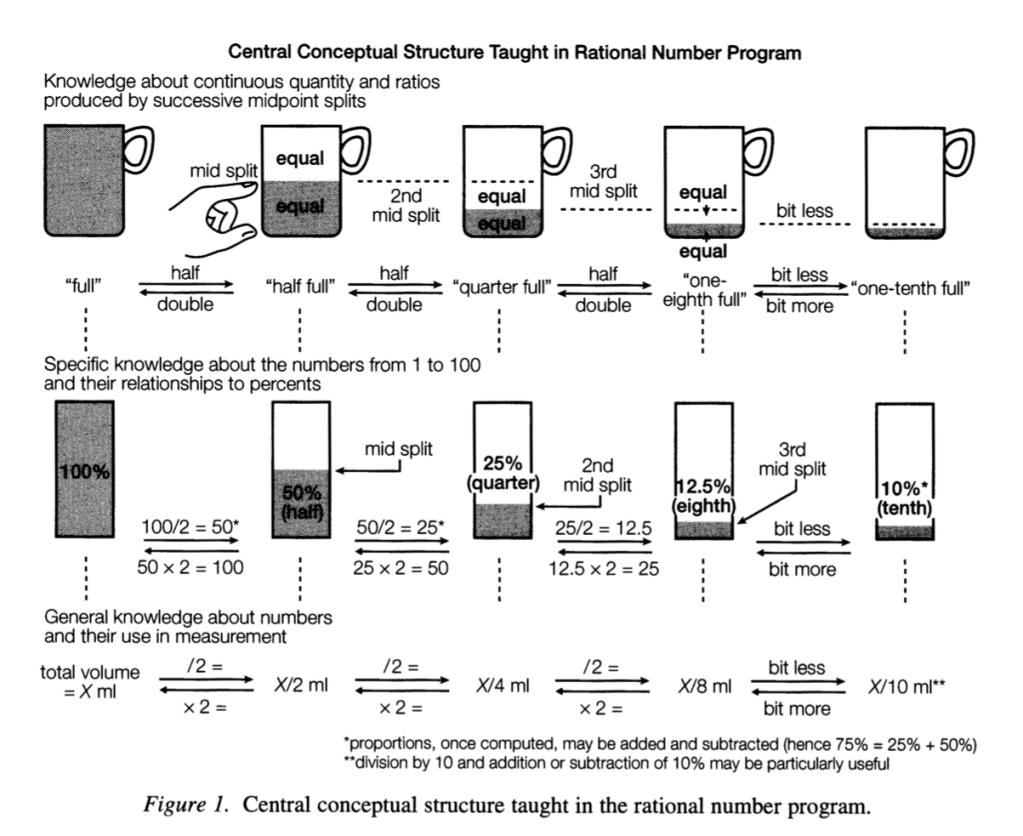
Moss, J., & Case, R. (1999). Developing children’s understanding of the rational numbers: A new model and an experimental curriculum. Journal for Research in Mathematics Education, 30, 122-147.
 Flavortown, USA